第330篇:AI Ops:智能网络运维的演进之路
关键词:AIOps、智能运维、机器学习、异常检测、预测性维护、生成式 AI、数字孪生、自动修复
一、引言
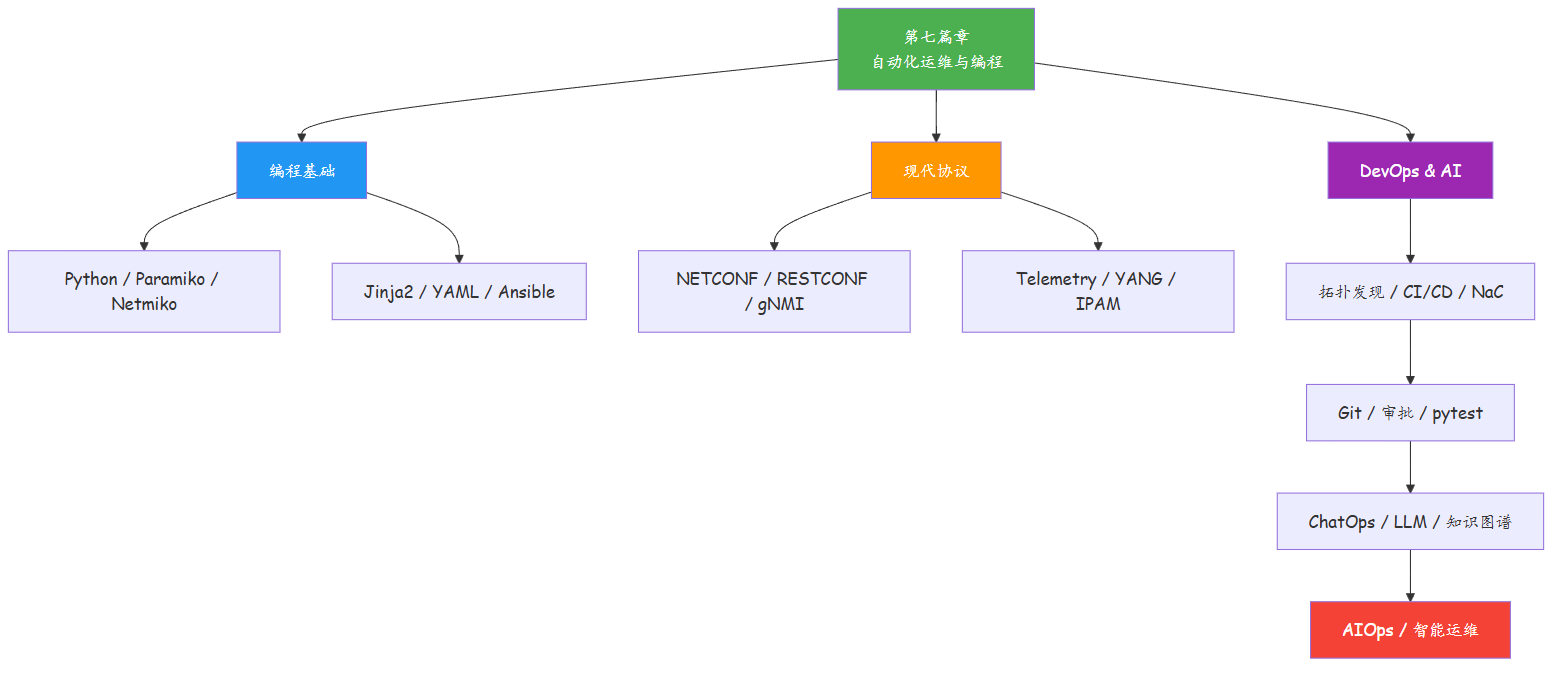
网络运维经历了从"人工运维"到"自动化运维"的演进,如今正迈入"智能化运维"(AIOps, Artificial Intelligence for IT Operations)的新阶段。回顾整个第七篇章"自动化运维与编程"的发展脉络:
- 第301-310篇:Python 编程与自动化工具入门(Paramiko、Netmiko、Ansible)
- 第311-320篇:现代网络管理协议与数据采集(NETCONF、Telemetry、IPAM)
- 第321-330篇:DevOps 与 AI 运维(拓扑发现、CI/CD、NaC、LLM 诊断、知识图谱)
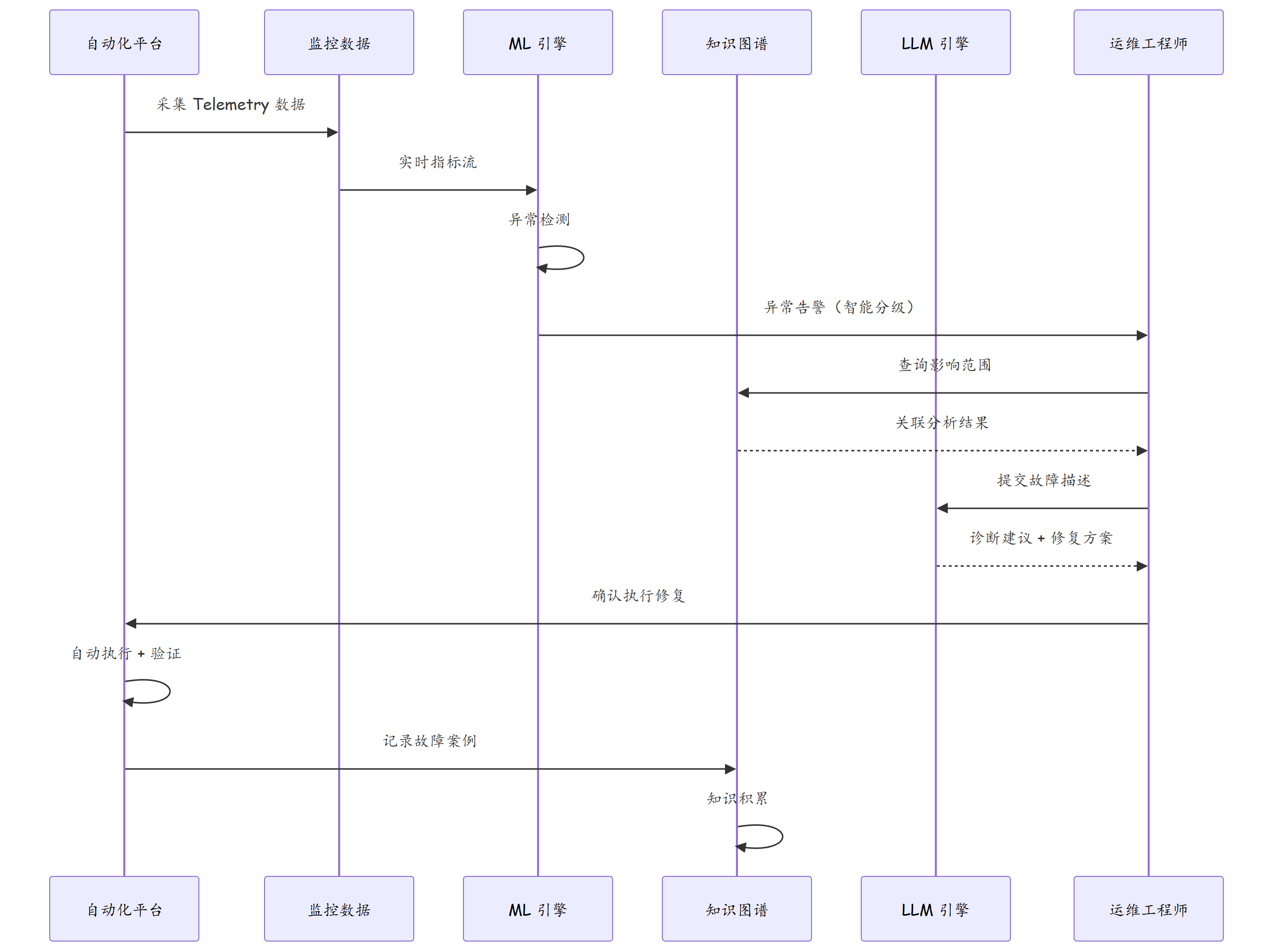
AIOps 不是对自动化的替代,而是在自动化基础上的智能化升级:自动化解决"怎么做",智能化解决"做什么"和"何时做"。
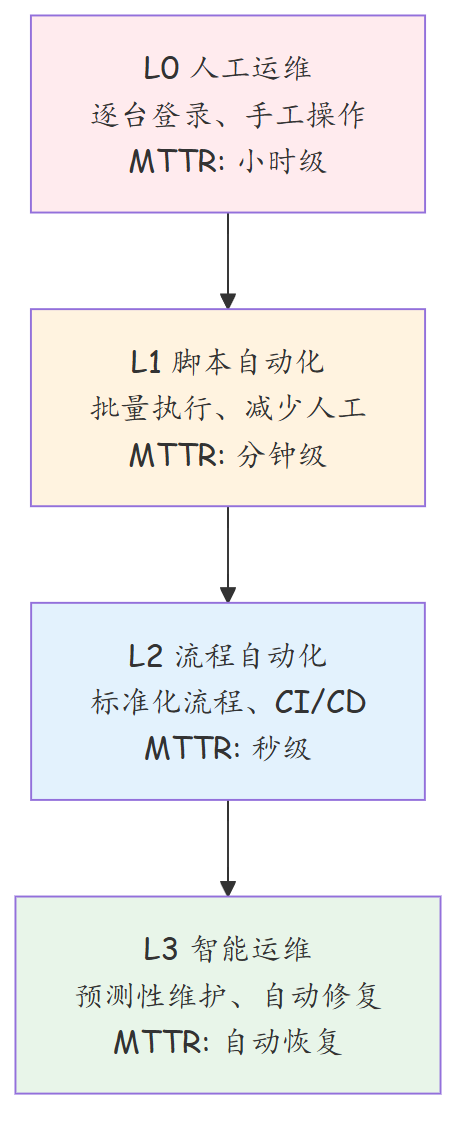
二、运维自动化演进路线图
2.1 四个阶段
| 阶段 | 核心特征 | 关键能力 | 代表技术 |
|---|---|---|---|
| L0: 人工运维 | 手工操作、经验驱动 | 逐台 CLI 操作 | SSH、Telnet |
| L1: 脚本自动化 | 脚本批量执行 | 批量命令下发、配置备份 | Python、Paramiko、Netmiko |
| L2: 流程自动化 | 标准化流程编排 | 变更审批、灰度部署、测试验证 | Ansible、GitLab CI、ChatOps |
| L3: 智能运维 | 数据驱动决策 | 异常检测、根因分析、预测性维护、自愈 | ML/AI、知识图谱、LLM |
2.2 各阶段对比
2.3 成熟度评估
某企业网络的运维成熟度自评:
| 评估维度 | 当前等级 | 评分 | 说明 |
|---|---|---|---|
| 配置管理 | L2 | 8/10 | 已实现 NaC + Git + CI/CD |
| 变更管理 | L2 | 7/10 | 审批流程自动化,回滚手动 |
| 监控告警 | L1→L2 | 6/10 | 阈值告警完善,智能告警待建设 |
| 故障诊断 | L1→L2 | 5/10 | 有部分自动化脚本,无智能分析 |
| 知识管理 | L1 | 4/10 | 文档散落,无结构化知识 |
| 综合 | L1→L2 | 6/10 | 向 L2 全面过渡中 |
三、AIOps 核心技术体系
3.1 智能异常检测
传统的阈值告警只能检测"已知"的异常,而基于机器学习的异常检测可以发现"未知"的异常模式:
# aiops/anomaly_detection.py
import numpy as np
from sklearn.ensemble import IsolationForest
from scipy import stats

class NetworkAnomalyDetector:
    """基于 Isolation Forest 的网络异常检测"""

    def __init__(self, contamination=0.05):
        self.model = IsolationForest(
            contamination=contamination,  # 异常比例
            random_state=42,
            n_estimators=200
        )
        self.is_trained = False
        self.feature_names = [
            'cpu_usage', 'memory_usage', 'interface_in_rate',
            'interface_out_rate', 'packet_loss_rate',
            'bgp_session_count', 'error_rate', 'latency'
        ]

    def train(self, historical_data):
        """使用历史正常数据训练模型"""
        X = np.array(historical_data)
        self.model.fit(X)
        self.is_trained = True
        print(f"模型训练完成,训练样本数: {len(X)}")

    def detect(self, current_metrics):
        """检测当前指标是否异常"""
        if not self.is_trained:
            raise RuntimeError("模型尚未训练")

        X = np.array([current_metrics])
        prediction = self.model.predict(X)
        score = self.model.score_samples(X)[0]

        # 识别哪些特征异常
        anomalous_features = self._identify_anomalous_features(current_metrics)

        return {
            'is_anomaly': prediction[0] == -1,
            'anomaly_score': float(score),
            'anomalous_features': anomalous_features,
            'severity': self._calculate_severity(score, anomalous_features)
        }

    def _identify_anomalous_features(self, metrics):
        """识别具体哪些指标异常"""
        anomalous = []
        for i, value in enumerate(metrics):
            # 使用 Z-Score 检测
            mean = self.model.estimators_[0].tree_.value[0][0]
            if abs(value - mean) > 2 * np.std([value]):
                anomalous.append(self.feature_names[i])
        return anomalous

    def _calculate_severity(self, score, anomalous_features):
        """计算异常严重程度"""
        if len(anomalous_features) >= 4:
            return 'critical'
        elif len(anomalous_features) >= 2:
            return 'major'
        elif anomalous_features:
            return 'warning'
        return 'normal'

# 使用示例
detector = NetworkAnomalyDetector()

# 训练数据(历史正常指标)
training_data = [
    [15, 45, 800, 600, 0.01, 12, 0, 5],
    [20, 50, 900, 700, 0.02, 12, 0, 6],
    # ... 更多正常样本
]
detector.train(training_data)

# 检测
current = [95, 92, 200, 100, 15.0, 8, 50, 150]
result = detector.detect(current)
print(f"异常检测结果: {result}")
# 输出: {'is_anomaly': True, 'severity': 'critical', ...}
3.2 告警关联与根因分析
# aiops/alarm_correlation.py
import networkx as nx
from datetime import timedelta

class AlarmCorrelationEngine:
    """告警关联引擎"""

    def __init__(self, topology_graph):
        """
        Args:
            topology_graph: NetworkX 图,包含设备拓扑关系
        """
        self.G = topology_graph

    def correlate_alarms(self, alarms, time_window_minutes=10):
        """
        关联时间窗口内的告警,识别根因告警

        Args:
            alarms: 告警列表,每项包含 device, type, timestamp, severity
            time_window_minutes: 时间窗口(分钟)

        Returns:
            关联组列表,每组包含根因告警和衍生告警
        """
        # 按时间排序
        sorted_alarms = sorted(alarms, key=lambda x: x['timestamp'])

        # 构建告警图
        alarm_graph = nx.DiGraph()

        for alarm in sorted_alarms:
            alarm_graph.add_node(
                alarm['alarm_id'],
                device=alarm['device'],
                type=alarm['type'],
                timestamp=alarm['timestamp'],
                severity=alarm['severity']
            )

        # 基于拓扑和时间关联告警
        for i, alarm1 in enumerate(sorted_alarms):
            for j, alarm2 in enumerate(sorted_alarms):
                if i == j:
                    continue

                # 时间窗口内
                time_diff = abs((alarm2['timestamp'] - alarm1['timestamp']).total_seconds())
                if time_diff > time_window_minutes * 60:
                    continue

                # 拓扑相邻
                if self._are_devices_related(alarm1['device'], alarm2['device']):
                    # 先发生的可能是根因
                    if alarm1['timestamp'] < alarm2['timestamp']:
                        alarm_graph.add_edge(
                            alarm1['alarm_id'], alarm2['alarm_id'],
                            relationship=self._determine_relationship(
                                alarm1, alarm2))

        # 识别根因告警(入度为 0 的节点)
        root_causes = [
            node for node, in_degree in alarm_graph.in_degree()
            if in_degree == 0
        ]

        # 构建关联组
        correlation_groups = []
        for root in root_causes:
            group = {
                'root_cause_alarm': alarm_graph.nodes[root],
                'derived_alarms': [
                    alarm_graph.nodes[neighbor]
                    for neighbor in alarm_graph.successors(root)
                ],
                'affected_devices': list(set([
                    alarm_graph.nodes[n]['device']
                    for n in [root] + list(alarm_graph.successors(root))
                ]))
            }
            correlation_groups.append(group)

        return correlation_groups

    def _are_devices_related(self, device1, device2):
        """判断两台设备在拓扑中是否相关(2 跳内)"""
        if device1 == device2:
            return True
        try:
            path = nx.shortest_path(self.G, device1, device2)
            return len(path) <= 3  # 2 跳内
        except nx.NetworkXNoPath:
            return False

    def _determine_relationship(self, alarm1, alarm2):
        """确定告警间的因果关系类型"""
        # 简单规则:上游设备告警 → 下游设备告警
        if alarm1['device'] in self._get_upstream_devices(alarm2['device']):
            return 'causes'
        return 'correlated'
3.3 预测性维护
# aiops/predictive_maintenance.py
from prophet import Prophet
import pandas as pd

class PredictiveMaintenance:
    """基于时间序列预测的预测性维护"""

    def predict_interface_failure(self, interface_metrics_history,
                                  device_name, interface_name):
        """
        预测接口故障

        Args:
            interface_metrics_history: DataFrame,包含 timestamp, error_rate, crc_errors
            device_name: 设备名称
            interface_name: 接口名称

        Returns:
            预测结果和故障概率
        """
        # 使用 Prophet 预测错误率趋势
        df = interface_metrics_history.copy()
        df = df.rename(columns={'timestamp': 'ds'})

        # 预测 CRC 错误趋势
        model_crc = Prophet()
        crc_data = df[['ds', 'crc_errors']].rename(
            columns={'crc_errors': 'y'})
        model_crc.fit(crc_data)

        future = model_crc.make_future_dataframe(periods=168, freq='H')  # 7天
        forecast = model_crc.predict(future)

        # 计算故障概率
        predicted_max_crc = forecast['yhat'].max()
        failure_threshold = 100  # CRC 错误阈值

        failure_probability = min(1.0, predicted_max_crc / failure_threshold)

        return {
            'device': device_name,
            'interface': interface_name,
            'predicted_max_crc_7d': float(predicted_max_crc),
            'failure_probability': float(failure_probability),
            'recommended_action': self._get_recommendation(failure_probability),
            'forecast_data': forecast[['ds', 'yhat', 'yhat_upper', 'yhat_lower']].tail(168)
        }

    def _get_recommendation(self, probability):
        """根据故障概率给出维护建议"""
        if probability > 0.8:
            return "紧急:建议立即更换光模块或光纤,CRC 错误趋势快速上升"
        elif probability > 0.5:
            return "预警:建议在下一维护窗口检查光模块和光纤连接"
        elif probability > 0.2:
            return "关注:接口指标略有上升,持续监控"
        return "正常:无需特别操作"
3.4 自动生成运维报告
# aiops/auto_report.py
from jinja2 import Template

DAILY_REPORT_TEMPLATE = """
# 网络运维日报
**日期**: {{ date }}
**生成时间**: {{ generated_at }}

## 一、网络概览

| 指标 | 数值 | 环比 |
|------|------|------|
| 在线设备数 | {{ stats.online_devices }} | {{ stats.device_change }} |
| 活跃链路数 | {{ stats.active_links }} | {{ stats.link_change }} |
| 当前告警数 | {{ stats.current_alarms }} | {{ stats.alarm_change }} |
| BGP 会话总数 | {{ stats.bgp_sessions }} | {{ stats.bgp_change }} |

## 二、严重告警

{% for alarm in critical_alarms %}
- **{{ alarm.device }}**: {{ alarm.description }} ({{ alarm.severity }})
{% endfor %}
{% if not critical_alarms %}
- 无严重告警 ✅
{% endif %}

## 三、变更摘要

{% for change in changes %}
- **{{ change.id }}**: {{ change.title }} → {{ change.status }}
{% endfor %}

## 四、容量预警

{% for warning in capacity_warnings %}
- **{{ warning.device }}/{{ warning.interface }}**:
  流量利用率 {{ warning.utilization }}% (阈值 {{ warning.threshold }}%)
{% endfor %}
{% if not capacity_warnings %}
- 无容量预警 ✅
{% endif %}

## 五、AI 洞察

{{ ai_insights }}
"""

def generate_daily_report(stats, critical_alarms, changes,
                          capacity_warnings, llm_client):
    """生成每日运维报告"""

    # 使用 LLM 生成 AI 洞察
    ai_insights = generate_ai_insights(stats, critical_alarms, llm_client)

    # 渲染报告
    template = Template(DAILY_REPORT_TEMPLATE)
    report = template.render(
        date=datetime.now().strftime('%Y-%m-%d'),
        generated_at=datetime.now().isoformat(),
        stats=stats,
        critical_alarms=critical_alarms,
        changes=changes,
        capacity_warnings=capacity_warnings,
        ai_insights=ai_insights
    )

    return report

def generate_ai_insights(stats, alarms, llm_client):
    """使用 LLM 生成 AI 洞察"""
    prompt = f"""
基于以下网络运维数据,给出 3-5 条 AI 洞察建议:

设备在线率: {stats.get('online_rate', 'N/A')}%
告警趋势: {'上升' if stats.get('alarm_trend', 0) > 0 else '下降'}
BGP 稳定性: {stats.get('bgp_stability', 'N/A')}%

严重告警类型分布:
{json.dumps(alarms, indent=2, ensure_ascii=False)}

请给出:
1. 当前网络健康度评估
2. 潜在风险预警
3. 优化建议
"""
    # 调用 LLM 生成洞察
    response = llm_client.chat.completions.create(
        model="gpt-4-turbo",
        messages=[{"role": "user", "content": prompt}],
        temperature=0.3
    )
    return response.choices[0].message.content
四、AIOps 落地实践路径
4.1 分阶段实施路线
| 阶段 | 时间周期 | 目标 | 关键交付物 |
|---|---|---|---|
| 阶段一:数据基础 | 1-3 月 | 统一数据采集与存储 | Telemetry 采集平台、时序数据库 |
| 阶段二:智能监控 | 3-6 月 | 异常检测与告警优化 | 动态基线告警、告警压缩与关联 |
| 阶段三:智能诊断 | 6-12 月 | 故障根因分析与处置建议 | 知识图谱、LLM 辅助诊断、自动报告 |
| 阶段四:自愈网络 | 12-24 月 | 预测性维护与自动修复 | 数字孪生、闭环自愈 |
4.2 告警压缩算法实现
告警压缩是 AIOps 的核心功能之一,通过将海量原始告警压缩为少量根因告警,降低运维人员的认知负担:
# aiops/alarm_compression.py
from collections import defaultdict
from datetime import timedelta

class AlarmCompressor:
    """告警压缩引擎"""

    def __init__(self, time_window_minutes=5):
        self.time_window = timedelta(minutes=time_window_minutes)
        self.compression_rules = {
            'LINK_DOWN': self._compress_link_down,
            'BGP_SESSION_DOWN': self._compress_bgp_down,
            'CPU_HIGH': self._compress_resource,
            'MEMORY_HIGH': self._compress_resource,
            'TEMPERATURE_HIGH': self._compress_resource,
        }

    def compress(self, alarms):
        """执行告警压缩"""
        # 按告警类型分组
        grouped = defaultdict(list)
        for alarm in alarms:
            grouped[alarm['type']].append(alarm)

        compressed = []
        for alarm_type, type_alarms in grouped.items():
            compressor = self.compression_rules.get(
                alarm_type, self._default_compress)
            result = compressor(type_alarms)
            compressed.extend(result)

        return compressed

    def _compress_link_down(self, link_downs):
        """压缩链路Down告警: 同一设备多条链路→单条根因"""
        device_groups = defaultdict(list)
        for alarm in link_downs:
            device_groups[alarm['device']].append(alarm)

        compressed = []
        for device, alarms in device_groups.items():
            compressed.append({
                'type': 'MULTI_LINK_DOWN',
                'device': device,
                'severity': 'critical' if len(alarms) >= 3 else 'major',
                'affected_links': [a['interface'] for a in alarms],
                'count': len(alarms),
                'root_cause': '疑似设备故障或电源异常',
                'timestamp': min(a['timestamp'] for a in alarms)
            })
        return compressed

    def _compress_bgp_down(self, bgp_downs):
        """压缩BGP Down告警: 同一AS多条会话→单条根因"""
        peer_groups = defaultdict(list)
        for alarm in bgp_downs:
            peer_groups[alarm['peer_as']].append(alarm)

        compressed = []
        for peer_as, alarms in peer_groups.items():
            compressed.append({
                'type': 'BGP_PEER_GROUP_DOWN',
                'peer_as': peer_as,
                'severity': 'critical',
                'affected_sessions': len(alarms),
                'devices': list(set(a['device'] for a in alarms)),
                'root_cause': '疑似对端AS可达性问题',
                'timestamp': min(a['timestamp'] for a in alarms)
            })
        return compressed

    def _compress_resource(self, resource_alarms):
        """压缩资源告警: 同一设备多指标→单条根因"""
        device_groups = defaultdict(list)
        for alarm in resource_alarms:
            device_groups[alarm['device']].append(alarm)

        compressed = []
        for device, alarms in device_groups.items():
            compressed.append({
                'type': f'RESOURCE_DEGRADATION_{device}',
                'device': device,
                'severity': 'major',
                'affected_metrics': [a['metric'] for a in alarms],
                'root_cause': '设备资源压力过大,建议检查业务负载',
                'timestamp': min(a['timestamp'] for a in alarms)
            })
        return compressed

    def _default_compress(self, alarms):
        """默认压缩: 按设备聚合"""
        device_groups = defaultdict(list)
        for alarm in alarms:
            device_groups[alarm['device']].append(alarm)

        compressed = []
        for device, alarms in device_groups.items():
            compressed.append({
                'type': f'MULTI_ALARM_{device}',
                'device': device,
                'severity': max(a['severity'] for a in alarms,
                               key=lambda s: {'critical': 3, 'major': 2, 'warning': 1}.get(s, 0)),
                'alarm_count': len(alarms),
                'alarm_types': list(set(a['type'] for a in alarms)),
                'timestamp': min(a['timestamp'] for a in alarms)
            })
        return compressed

# 使用示例
compressor = AlarmCompressor(time_window_minutes=5)
raw_alarms = [
    {'type': 'LINK_DOWN', 'device': 'PE-BJ-01', 'interface': 'GE1/0/1', 'severity': 'major', 'timestamp': '2026-09-06T10:00:00'},
    {'type': 'LINK_DOWN', 'device': 'PE-BJ-01', 'interface': 'GE1/0/2', 'severity': 'major', 'timestamp': '2026-09-06T10:00:01'},
    {'type': 'LINK_DOWN', 'device': 'PE-BJ-01', 'interface': 'GE1/0/3', 'severity': 'major', 'timestamp': '2026-09-06T10:00:02'},
    {'type': 'BGP_SESSION_DOWN', 'device': 'PE-BJ-01', 'peer_as': 65100, 'severity': 'critical', 'timestamp': '2026-09-06T10:00:05'},
]
compressed = compressor.compress(raw_alarms)
print(f"压缩前: {len(raw_alarms)} 条告警 → 压缩后: {len(compressed)} 条告警")
4.3 根因分析代码实现
# aiops/root_cause_analysis.py
import networkx as nx
from datetime import timedelta

class RootCauseAnalyzer:
    """基于拓扑和时序的根因分析引擎"""

    def __init__(self, topology: nx.Graph, alarm_history):
        self.G = topology
        self.alarm_history = alarm_history

    def analyze(self, current_alarms, time_window_minutes=10):
        """执行根因分析"""
        # 1. 构建告警关联图
        alarm_graph = self._build_alarm_graph(current_alarms, time_window_minutes)

        # 2. 识别根因告警(入度为0的节点)
        root_causes = self._find_root_causes(alarm_graph)

        # 3. 拓扑定位影响传播路径
        propagation_paths = self._find_propagation_paths(root_causes)

        # 4. 生成根因分析报告
        report = self._generate_report(root_causes, propagation_paths)

        return report

    def _build_alarm_graph(self, alarms, time_window_minutes):
        """基于时间和拓扑构建告警关联图"""
        G = nx.DiGraph()

        for alarm in alarms:
            G.add_node(alarm['alarm_id'], **alarm)

        for i, a1 in enumerate(alarms):
            for j, a2 in enumerate(alarms):
                if i == j:
                    continue
                # 时间先后 + 拓扑关联
                time_diff = (a2['timestamp'] - a1['timestamp']).total_seconds()
                if 0 < time_diff < time_window_minutes * 60:
                    if self._are_topologically_related(
                            a1['device'], a2['device']):
                        G.add_edge(a1['alarm_id'], a2['alarm_id'],
                                  time_diff=time_diff)

        return G

    def _find_root_causes(self, alarm_graph):
        """找到入度为0的节点(根因告警)"""
        root_nodes = [n for n, d in alarm_graph.in_degree() if d == 0]
        return [alarm_graph.nodes[n] for n in root_nodes]

    def _find_propagation_paths(self, root_causes):
        """追踪故障传播路径"""
        paths = []
        for root in root_causes:
            device = root['device']
            # BFS遍历影响范围
            affected = set()
            queue = [device]
            visited = {device}
            while queue:
                current = queue.pop(0)
                for neighbor in self.G.neighbors(current):
                    if neighbor not in visited:
                        affected.add(neighbor)
                        visited.add(neighbor)
                        queue.append(neighbor)
            paths.append({
                'root_device': device,
                'affected_devices': list(affected),
                'impact_scope': len(affected)
            })
        return paths

    def _generate_report(self, root_causes, propagation_paths):
        """生成根因分析报告"""
        return {
            'root_cause_alarms': root_causes,
            'propagation_analysis': propagation_paths,
            'total_affected': sum(p['impact_scope'] for p in propagation_paths),
            'recommended_actions': [
                self._get_recommendation(rc) for rc in root_causes
            ]
        }

    def _get_recommendation(self, alarm):
        """根据告警类型生成处置建议"""
        recommendations = {
            'LINK_DOWN': '检查物理链路、光模块和光纤连接',
            'BGP_SESSION_DOWN': '检查BGP邻居配置、路由可达性和路由策略',
            'CPU_HIGH': '检查是否存在路由震荡或异常流量',
            'MEMORY_HIGH': '检查是否存在内存泄漏或大表项',
            'TEMPERATURE_HIGH': '检查机房温度和风扇运转状态',
        }
        return recommendations.get(alarm.get('type', ''),
                                   '请根据告警详情进一步排查')

    def _are_topologically_related(self, device1, device2, max_hops=3):
        """检查两台设备是否在拓扑中相关(max_hops跳内)"""
        try:
            path = nx.shortest_path(self.G, device1, device2)
            return len(path) - 1 <= max_hops
        except nx.NetworkXNoPath:
            return False
4.4 异常检测模型对比
| 模型 | 适用场景 | 优点 | 缺点 | 数据需求 |
|---|---|---|---|---|
| Isolation Forest | 多维指标异常检测 | 无需标签、速度快 | 难以解释具体原因 | 历史正常数据 |
| LSTM-AE | 时序异常检测 | 捕捉时间依赖、精度高 | 训练复杂、需要大量数据 | 长周期时序数据 |
| Prophet | 趋势+季节性预测 | 处理节假日效应 | 需要足够的历史周期 | 至少2个完整周期 |
| 3-Sigma | 简单阈值检测 | 实现简单、易理解 | 固定阈值不适应变化 | 均值和方差 |
| DBSCAN | 聚类异常检测 | 发现任意形状异常簇 | 参数敏感 | 多维指标数据 |
4.2 从自动化到智能化的过渡
十、总结
| 维度 | 自动化运维 (L2) | 智能运维 (L3/AIOps) | 演进价值 |
|---|---|---|---|
| 告警方式 | 静态阈值告警 | 动态基线 + 异常检测 | 告警量减少 80%+ |
| 故障诊断 | 人工排查 + 脚本辅助 | 根因自动分析 + 处置建议 | MTTR 缩短 70%+ |
| 运维决策 | 经验驱动 | 数据驱动 + AI 推荐 | 决策质量显著提升 |
| 变更管理 | 标准化流程 + 测试验证 | 风险自动评估 + 影响预测 | 变更故障率降低 50%+ |
| 知识管理 | 文档 + 案例库 | 知识图谱 + LLM 问答 | 知识利用率 3 倍提升 |
| 维护模式 | 故障后修复 | 预测性维护 | 从被动到主动 |
第七篇章核心知识体系回顾
故障案例:AIOps 实现从被动到主动的转变
某金融企业网络在引入 AIOps 体系后:
引入前(2025年): - 年均故障数:47 次 - 平均 MTTR:35 分钟 - 告警风暴月均:3 次(单次 500+ 告警) - 运维人员:15 人
引入后(2026年): - 年均故障数:12 次(↓74%) - 平均 MTTR:8 分钟(↓77%) - 告警风暴月均:0 次(告警压缩率 92%) - 运维人员:15 人(不变,但工作强度显著降低)
关键转变:通过预测性维护,在光模块 CRC 错误达到阈值前 2 周发出预警,运维人员在维护窗口提前更换,避免了 3 次潜在的严重故障。
思考题
- AIOps 的落地需要大量高质量数据支撑,对于数据基础薄弱的企业,如何规划从"无数据"到"数据驱动"的演进路径?
- 当 AI 生成的诊断建议与人工经验不一致时,如何建立信任机制?在什么条件下可以允许 AI 直接执行修复操作?
下篇预告:第331篇《大型企业园区网络规划案例》——进入第八篇章,从真实的企业园区场景出发,综合运用前面所学的全部技术知识,完成一套完整的网络规划与部署方案。